
Finding the entrance to the Latvian Museum of Pharmacy along R. Vāgnera iela can be tricky, as the heavy wooden doors often make the 18th-century building look completely closed from the outside. Push the antique handle anyway, and you immediately step out of the crowded Old Town into a remarkably quiet space that smells strongly of dried herbs. This hidden spot offers a surprisingly deep dive into medical history without eating up your entire afternoon.
- Location: Riharda Vāgnera iela 13, Riga Old Town
- Entrance Fee: €2 for adults, €1 for students
- Opening Hours: Tuesday to Saturday, 10:00 AM - 6:00 PM
- Duration: 30 to 45 minutes
- Accessibility: Not wheelchair accessible due to steep historical staircases
What to Expect Inside the 18th-Century Houses
The museum occupies three interconnected residential buildings that once belonged to a carriage master before becoming Soviet communal flats. The interior layout feels like a maze. You walk through rooms dedicated to different eras of pharmacology, tracking the evolution of medicine in Latvia. The collection goes far beyond simple pill bottles. You find everything from intricate brass scales to Alexander II's impressive travel first aid kit.
The lighting is dim, the wooden cabinets packed with fragile glassware. Staff members usually wait near the exhibits, ready to demonstrate how various medical tools were used decades ago. English translations accompany most major displays, but having a quick chat with the museum workers reveals fascinating details about the old prescription signatures. It's also worth knowing that many antique containers on display retain their original contents, some still potent, so touching them is strictly off-limits for good reason.
The Alchemist's Laboratory and Folk Healer's Hut
Head down to the lower levels to find the most atmospheric sections of the museum. The folk healer's hut showcases the roots of traditional medicine. Bundles of dried plants hang from the ceiling. The air is heavy, the atmosphere surprisingly authentic. Next to it sits the alchemist's laboratory. This space looks straight out of the Middle Ages, complete with strange molds and equipment for preparing early medications.
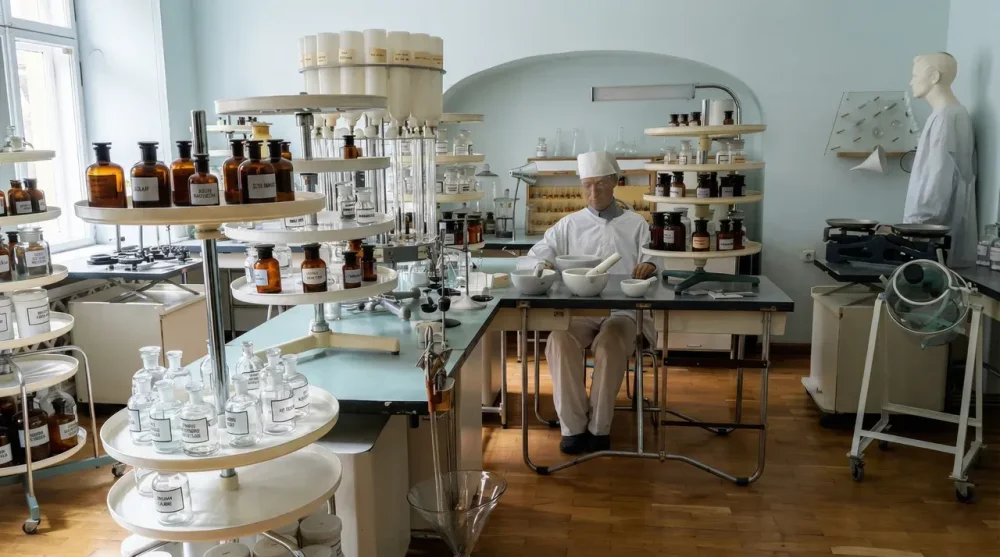
Soviet-Era Assistant Pharmacist's Office
Moving upstairs brings a sharp contrast in time. The Soviet-era displays feature a highly structured assistant pharmacist office. You see exactly where drug mixtures and powders were produced in the mid-20th century. The sheer volume of pharmaceutical vessels is staggering. This stark transition from mystical alchemy to industrial Soviet medicine highlights the rapid shift in Baltic healthcare.
The Hidden Courtyard: Healing Herb Garden
Most tourists walking past the building never realize there is a lush backyard hidden right in the center of the Old Town. Step outside into the small healing herb garden. The noise of the city completely disappears here. You find an old black sauna, historically used for both hygiene and folk healing practices, sitting quietly in the corner.
The courtyard walls feature beautiful stained glass panels created by artist T. Grasis. This outdoor section provides a peaceful break during your Riga visit in 2026, especially if the main squares get too crowded. If you enjoy exploring offbeat collections across the Baltic states, the Estonian History Museum in Tallinn covers a similarly wide sweep of regional heritage across multiple locations worth combining into a broader itinerary.
Practical Information for Visitors
You pay the admission fee in the small room to the left of the main entrance. The ticket price of €2 makes this one of the most budget-friendly cultural stops in the city. You need roughly 40 minutes to comfortably see all five exhibition halls and the garden. You can take photographs freely throughout the building, but touching the fragile antique tools is strictly prohibited.
The museum is open Tuesday to Saturday, 10:00 AM to 6:00 PM, and closed on Sundays and Mondays. The Riga Pass does not cover admission here, so you pay separately at the door regardless of which city card you carry. Arrive at least 45 minutes before closing to make sure you have enough time for all the halls and the courtyard.
Accessibility Note for Wheelchair Users
The museum operates entirely within protected historical monuments. There are no elevators. Navigating between the different halls requires climbing steep, narrow wooden staircases. The uneven floorboards and tight corridors make it physically impossible for wheelchair users or travelers with severe mobility limitations to explore the upper floors or the basement laboratories.