If you have ever taken a long international flight, you already know that jet lag is exhausting. But you know what makes it significantly worse? Getting absolutely zero sleep because your head is bobbing all over the place and you are getting no support from your neck pillow. These are the moments when you are probably silently envying those in business and first class.
The good news is that it does not have to be this way. You can sleep on flights, even in the middle seat of economy, and you can recover from jet lag fast so you can enjoy the journey from day one. While a typical neck pillow and melatonin used to be my go-to, I have learned far more effective ways to adjust quickly. Here are my top science-backed tips and tools to help you feel refreshed way sooner.
Understanding the Enemy: What is Jet Lag?
The first step to beating jet lag is understanding what is actually happening in your body. All of us have an internal clock, or circadian rhythm, that controls sleep, digestion, and hormones. It relies heavily on light to stay on a natural 24-hour cycle. When you land in a new time zone and time jumps suddenly, that rhythm gets completely thrown off. This is what we call jet lag. It is not just about being tired; it is a physiological confusion that affects your metabolism and mood.
1. Sync Your Internal Clock (Before You Fly)
Jet lag is not just about sleep; it also affects your digestion and metabolism. Research shows that meal timing and light exposure are two of the most powerful ways to reset your internal clock.
Here is the strategy I use on every long-haul flight: The moment I board the plane, I switch my phone and watch to my destination time zone. Then, I try to match my meals and light exposure to that time zone immediately.
If it is nighttime where I am going, I eat something very light or skip the meal entirely and keep light to a minimum to signal to my body that it is time to rest. If it is daytime at my destination, I eat a full meal and try to get as much light exposure as possible. This simple mental and physical shift helps your body start adjusting before you even land.
2. The Gear: How to Actually Sleep in Economy
One of the biggest challenges when adjusting to a new time zone is getting quality sleep on the plane. This is especially difficult if you are someone who just cannot get comfortable in economy class.
I recently started using the Traveler Pillow, and it has been a total game changer for my travel routine. Unlike traditional neck pillows that leave you bobbing around, this pillow uses a specific face cradle design that supports your head in a forward-leaning, natural sleep posture. This is crucial because it mimics the way you might sleep on a massage table or at your desk, which is often more natural for your spine than trying to sleep upright.
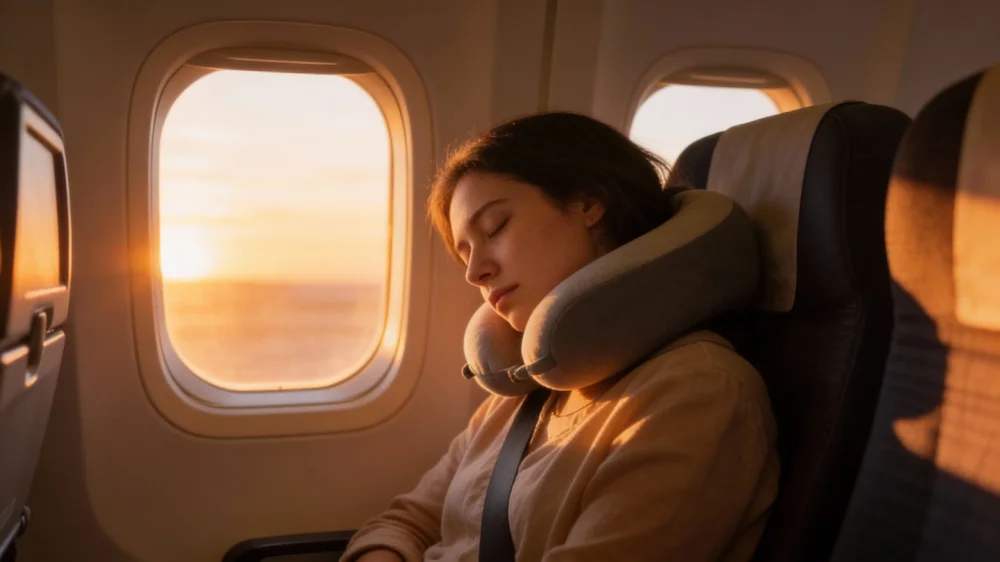
The legs of the pillow telescope and adjust in height, so no matter how tall you are, you can make it perfectly supportive. It effectively eliminates the head bobbing that wakes you up every 5 minutes. Plus, it is surprisingly lightweight and comes with a backpack carrying case. You can even wear your headphones or an eye mask while using it without feeling claustrophobic.
3. Strategic Flight Selection
If you have the flexibility, opt for daytime flights or routes that allow you to arrive at a reasonable hour instead of the middle of the night. Studies show that traveling during the day and giving your body some layover time to adjust can dramatically reduce that zombie feeling on arrival.
If a daytime flight is not possible, try to book a flight that lands in time for you to catch at least a little bit of daylight. Sunlight is your body's best natural reset button. Seeing natural light immediately upon arrival helps suppress melatonin production and signals to your brain that it is time to be awake.
4. Create a Sleep-Friendly Environment
Once you arrive at your destination, setting yourself up for good rest is non-negotiable. Many hotels now offer blackout curtains, circadian lighting, and white noise machines, but you do not need a luxury hotel to get a good night's sleep.
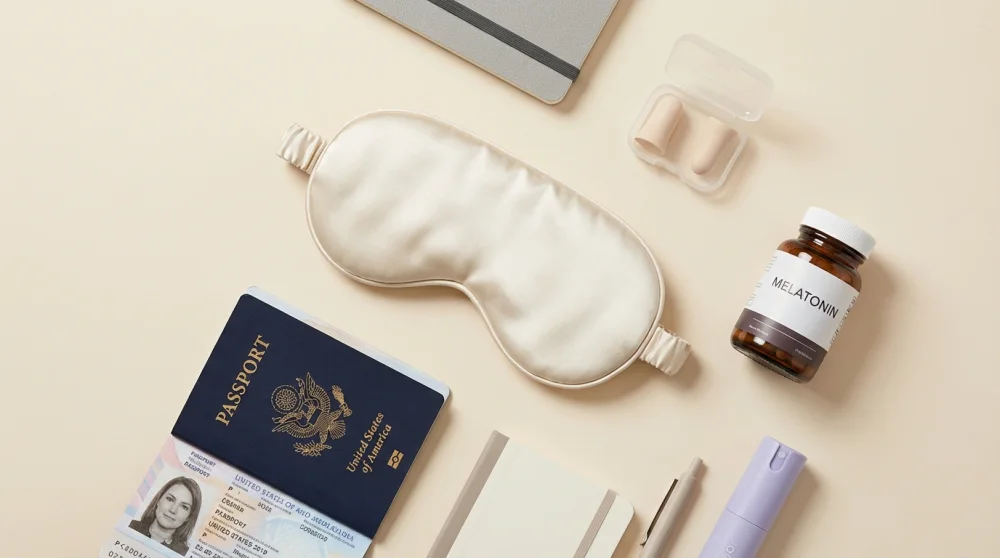
You can recreate a sleep-friendly environment anywhere with simple tools. I always pack a high-quality eye mask, earplugs, and sometimes portable blackout curtains. A travel sound machine or a white noise app on your phone can also be effective in drowning out unfamiliar city sounds. Creating a dark, quiet sanctuary helps your brain understand that it is safe to power down, regardless of what time your body thinks it is.
5. Movement and Recovery
Movement is one of the most underrated jet lag hacks, but the timing matters.
If you are traveling East (e.g., New York to London) and need to get sleepy earlier, do something gentle in the morning after you land, like a walk, yoga, or light stretching.

If you are traveling West (e.g., London to New York) and need to stay awake longer, plan something active in the afternoon. A run, a bike ride, or even just a long sightseeing walk works wonders. Getting sunlight combined with movement helps your circadian rhythm stabilize much faster and shakes off that heavy, groggy feeling after a long flight.
With these five simple tips, you will find yourself getting over jet lag way faster than before. No more fighting exhaustion for days or wasting those precious first few moments of your adventure. Happy travels.
![Jekyll Island Campground Review: Best Sites & [year] Guide](https://www.rotasenin.com/uploads/2025/12/jekyll-island-campground-rv-sites.webp)





Comments (0)
Sign in to comment
Report