Imagine landing in Berlin or Munich with just one word in your pocket. Usually, that sounds like a nightmare scenario. But if that specific word is Bitte, you are surprisingly well-equipped to survive. Most language learners memorize vocabulary lists for hours, yet they often miss the versatility of this single expression. It works like a Swiss Army Knife in the German language.
You can use it to ask for things, to apologize, to grant permission, or even to express that you didn't hear someone clearly. Understanding how to wield this word correctly will instantly make you sound more like a local and less like a confused tourist.
This guide breaks down the nuances of Bitte so you can use it with confidence in any social situation.
Why 'Bitte' is the Chameleon of German Language
German is often perceived as a rigid language with strict grammatical rules. While that is true for sentence structure, Bitte breaks the mold by being incredibly flexible. It changes its meaning entirely based on the context and your tone of voice. You don't need to master complex grammar to be polite. You just need to know which version of Bitte the situation demands.
If you are planning a trip and looking for general advice on navigating new cultures, our travel tips archive is a great place to start. Just like learning key phrases for language in Turkey can transform your experience there, mastering Bitte changes the game in German-speaking countries.
1. The Classic: Saying Please
This is the usage most people are familiar with. When you want to request something politely, Bitte is your go-to word. You can place it at the beginning, in the middle, or at the end of a sentence. However, for a quick interaction like ordering coffee, adding it to the end is the most natural way.
- Ein Kaffee, bitte. (A coffee, please.)
- Die Rechnung, bitte. (The check, please.)
Using it creates an instant buffer of politeness. In Germany, directness is appreciated, but demanding something without this magic word can be seen as rude.
2. The Response: You’re Welcome
One of the first things you notice in a German conversation is the ping-pong effect of Bitte and Danke. When someone thanks you for holding a door or passing the salt, you simply reply with Bitte.
In this context, it acts as a shorthand for You are welcome. You might also hear variations like Bitte sehr or Bitte schön. Don't overthink it. If you say Danke, and they say Bitte, the transaction is complete and polite.
3. The Offering: Here You Go
This scenario often confuses beginners. Imagine you are at a restaurant. The waiter approaches your table with your food. As they place the plate down, they say Bitte schön or simply Bitte.
They are not saying please or you're welcome here. In this specific moment, it translates to Here you go or I serve this to you. It is a verbal gesture of handing something over. Your correct response in this situation is Danke.
4. The Pardon?: When You Didn't Hear It
We have all been there. Someone speaks too fast, or the background noise is too loud. Instead of staring blankly, you can use Wie bitte? or just Bitte? with a rising intonation at the end.
This signals to the speaker that you didn't catch what they said. It is the polite equivalent of Pardon? or Excuse me?.
Tone check: Be careful with your tone here. A soft, rising Bitte? is polite. A sharp, loud Bitte! can sound aggressive, like What did you just say to me?. Keep it gentle.
5. The Approval: Go Ahead or After You
You are standing at a doorway at the same time as someone else. You want to let them pass first. You gesture with your hand and say Bitte.
Here, it means After you or Go ahead. It grants permission or signals that you are stepping aside. You can also use it if someone asks to sit in the empty seat next to you. A nod and a Bitte let them know the seat is free and they are welcome to take it.
Bitte Schön vs. Bitte Sehr: Is There a Difference?
You will hear both Bitte schön and Bitte sehr constantly. Learners often stress about which one to use. The honest answer is that the difference is negligible.
- Bitte schön: Literally please beautifully. It feels slightly warmer and is very common in everyday service interactions.
- Bitte sehr: Literally please very much. It can sound a tiny bit more formal, but in practice, they are interchangeable.
Choose the one that flows better for you. The local listener will appreciate the effort regardless of which variation you pick.
Real-Life Scenarios: How to Sound Like a Local
To truly master this word, you need to see it in action. Here is a quick cheat sheet for common daily interactions you will face in Germany, Austria, or Switzerland.
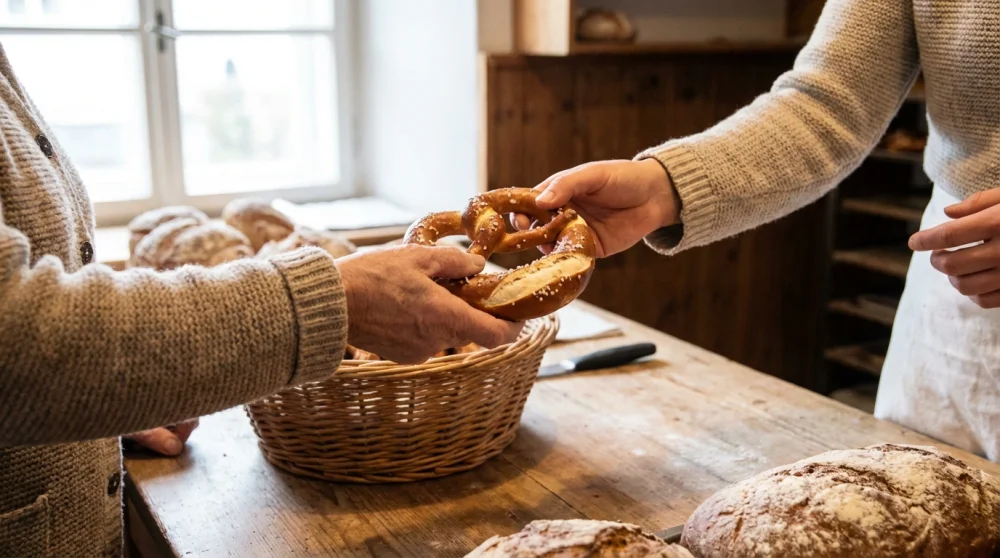
At the Bakery
- You: Ein Brötchen, bitte. (Ordering)
- Baker: (Hands it over) Bitte schön. (Here you go)
- You: Danke. (Thanks)
- Baker: Bitte. (You're welcome)
On the Phone
- Caller: Speak very fast German.
- You: Wie bitte? (Pardon me?)
In a Crowded Train
- Stranger: Is this seat taken?
- You: (Gesturing to the seat) Bitte. (Go ahead)
Mastering these small interactions builds your confidence. You stop worrying about grammar tables and start communicating. Bitte is the bridge that connects you to the local culture, proving that sometimes, one word really is enough to get by.
![Orca Whale Watching in Washington: The Ultimate [year] Guide (Seattle & San Juan Islands)](https://www.rotasenin.com/uploads/2026/01/washington-best-time-to-see-orca-whale-watching.webp)
![Museumplein Amsterdam: Things to Do, Museums & Events ([year])](https://www.rotasenin.com/uploads/2026/01/museumplein-amsterdam-three-museums.webp)


Comments (0)
Sign in to comment
Report