Imagine a place where sunlight never touched the ground. A concrete labyrinth where 50,000 people lived, worked and died within a space the size of a few football fields. There were no laws, no police patrols and no building codes.
You could walk from one end of the city to the other without ever touching solid earth, navigating through a web of dripping pipes and tangled electrical wires. This was not a sci-fi movie set or a dystopian video game level. This was the Kowloon Walled City.
For decades, this anomaly in the heart of Hong Kong fascinated architects, frightened outsiders and provided a haven for refugees and criminals alike. While the physical walls came down in the early 90s, the legend of the Walled City only continues to grow. If you are visiting Hong Kong, you cannot miss the chance to stand on this historic ground. Here is what you need to know about the most densely populated place to ever exist and how to explore what remains of it today.
The City of Darkness: A Historical Glitch
You might wonder how such a place was allowed to exist in a modern metropolis like Hong Kong. The answer lies in a strange diplomatic loop. Originally a Chinese military fort, the site became a political no-man's-land when the British leased the New Territories in 1898. China claimed jurisdiction but did not enforce it, and the British adopted a hands-off policy.
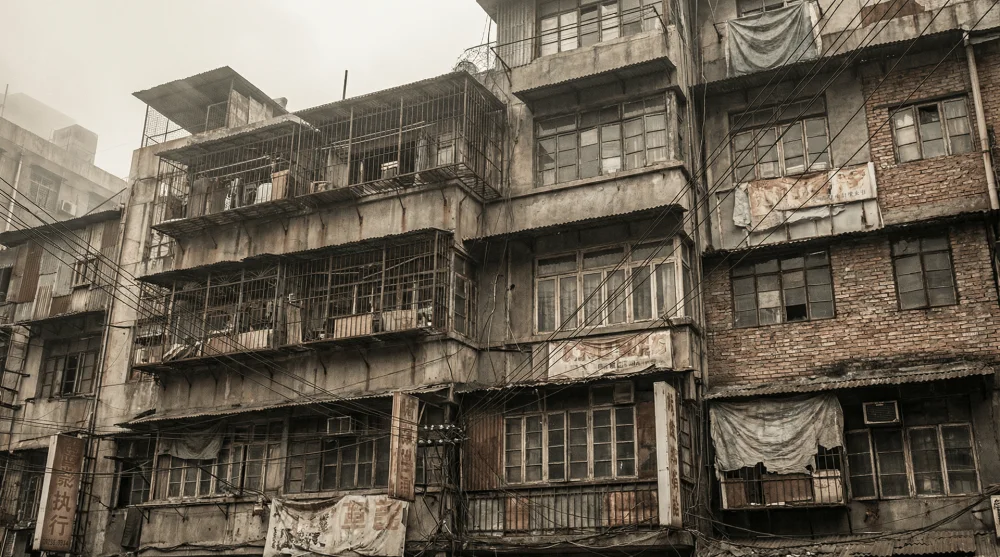
Left to its own devices, the city grew organically. Without architects or engineers, residents simply built rooms on top of rooms. Buildings leaned against each other for support, rising up to 14 stories high. It became a monolithic block of concrete, buzzing with life 24 hours a day. It was a glitch in history, a place where the normal rules of society simply did not apply.
Inside the Walls: A Cyberpunk Reality
Stepping inside the Walled City was like entering a different dimension. The streets were narrow corridors, barely a meter wide, illuminated by fluorescent lights that flickered day and night. The air was thick with the smell of charcoal smoke, incense and damp concrete.
The Lawless Order
While it had a reputation for danger, life inside was surprisingly organized. You would find schools, temples, noodle factories and thousands of small businesses operating in the shadows. The city was famous for its unlicensed dentists. Because Hong Kong laws had no power here, dentists from mainland China who could not practice locally set up shop in the Walled City. Their clinics were often dirty and dark, but they were cheap, attracting clients from all over Hong Kong.
Triad gangs, specifically the 14K and Sun Yee On, controlled the opium parlors and brothels in the eastern section. However, for the majority of residents, daily life was about survival and community. A strange harmony existed in the chaos. Residents formed their own volunteer groups to clean the streets and put out fires, proving that people can find order even in the absence of government.
Living Without Sun
The lower levels of the city were perpetually wet. Water from thousands of handmade pipes dripped constantly, requiring residents to walk with umbrellas even when inside. If you lived on the lower floors, you might not see the sky for weeks. The only escape was the roof.
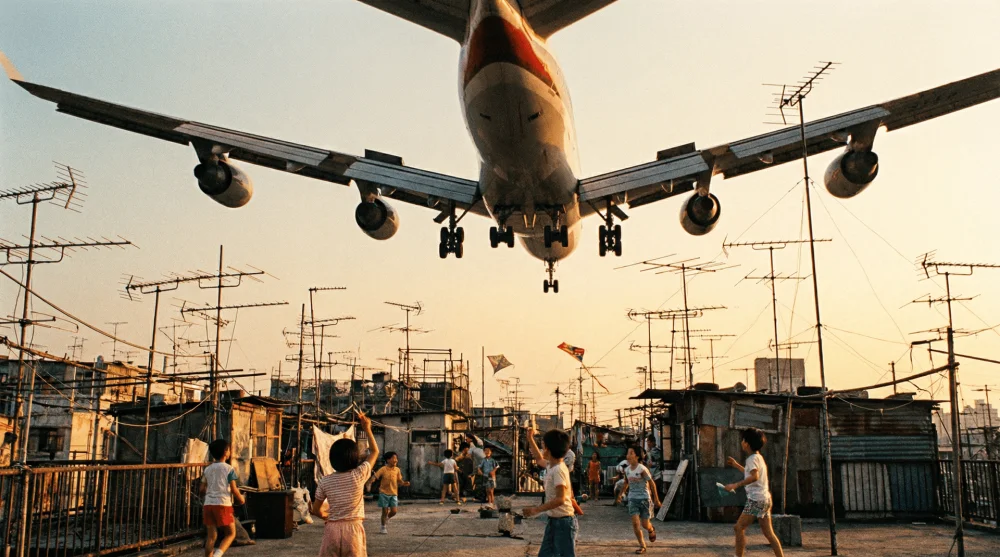
The rooftop was the city's lungs. It was a chaotic playground of television antennas, drying laundry and playing children. It was the only place to breathe fresh air, although your conversation would frequently be drowned out by the roar of airplanes. The famous Kai Tak Airport was so close that pilots could almost see into the apartments as they made their dangerous descent over Kowloon.
The Fall of the Walled City
By the late 80s, both the British and Chinese governments decided the city had to go. It was a health hazard and a diplomatic embarrassment. Despite protests from residents who had built their entire lives within these walls, the eviction process began.
The demolition took over a year. It was not destroyed by war, but by wrecking balls. When the dust settled, the site was transformed into a traditional Jiangnan-style garden. But the memory of the city proved impossible to erase. It lives on in movies like Bloodsport, inspired the setting of the game Stray, and remains the ultimate reference point for cyberpunk aesthetics worldwide.
Kowloon Walled City Park: Traces of the Past
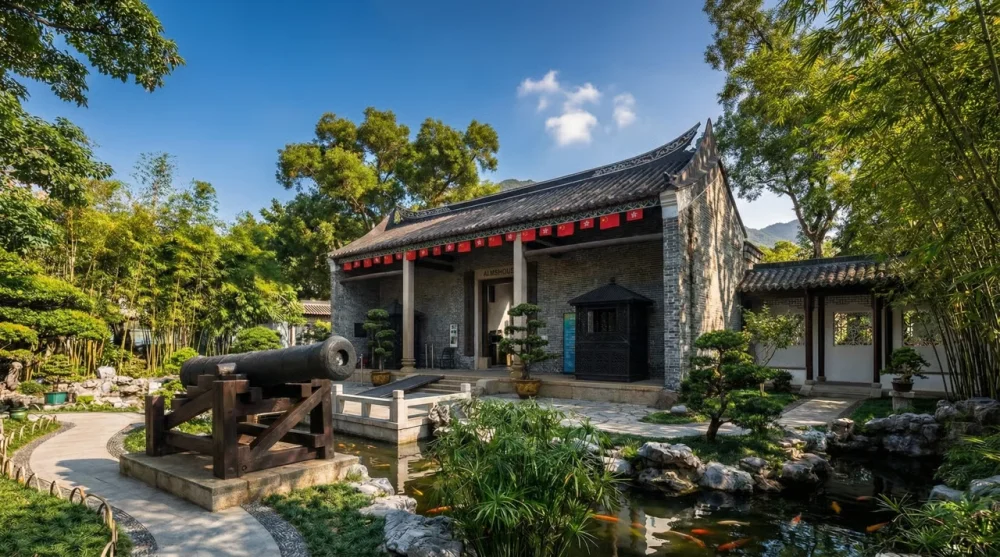
Today, you will find the Kowloon Walled City Park on the exact site where the slum once stood. It is peaceful, green and incredibly quiet, a stark contrast to the noise of the past. However, if you know where to look, you can still find the ghosts of the Walled City.
The Yamen
This is the most important structure in the park. The Yamen is the original administrative building from the Qing Dynasty fort. It is the only building that survived the demolition of the slum. Remarkably, during the Walled City era, this historic building was swallowed up by the high-rises, used as a community center, a school and a clinic. Today, it stands fully restored and houses an exhibition about the city's history.
The Old South Gate
During the demolition, archeologists made a stunning discovery. Buried under the foundations of the squatter buildings were the original granite plaques of the South Gate. You can visit this excavated site today. Seeing the original stone sign that reads Kowloon Walled City is a chilling reminder of the fortress that started it all.
The Bronze Model
Do not leave the park without finding the large bronze model of the Walled City near the entrance. It is the only way to truly grasp the scale of the madness. You can touch the miniature high-rises and trace the impossible labyrinth of alleyways. It gives you a physical sense of how 33,000 families were packed into such a tiny space.
Practical Tips for Your Visit
Visiting the park is one of the most unique things you can do in Hong Kong. It offers a deep dive into a history that is rapidly fading.
- Admission: Entry to the park is completely free for everyone.
- Getting There: The easiest way is to take the MTR to Sung Wong Toi Station. Take Exit B3 and follow the signs. It is a short and pleasant walk.
- Best Time to Visit: The park is open from morning until late evening. Visiting in the late afternoon allows you to see the park in daylight and then experience the atmospheric lighting as the sun goes down.
- Food: You are in Kowloon City District, which is famous among locals for having some of the best Thai food in Hong Kong. After your walk, explore the surrounding streets for an authentic meal.
The Kowloon Walled City is gone, but the ground you walk on remembers the weight of history. It serves as a powerful reminder of human resilience and the extraordinary lengths people will go to build a home.

![Madame Tussauds Amsterdam: Ticket Prices, Figures and Tips [year]](https://www.rotasenin.com/uploads/2026/01/madame-tussauds-amsterdam-music.webp)
Comments (0)
Sign in to comment
Report