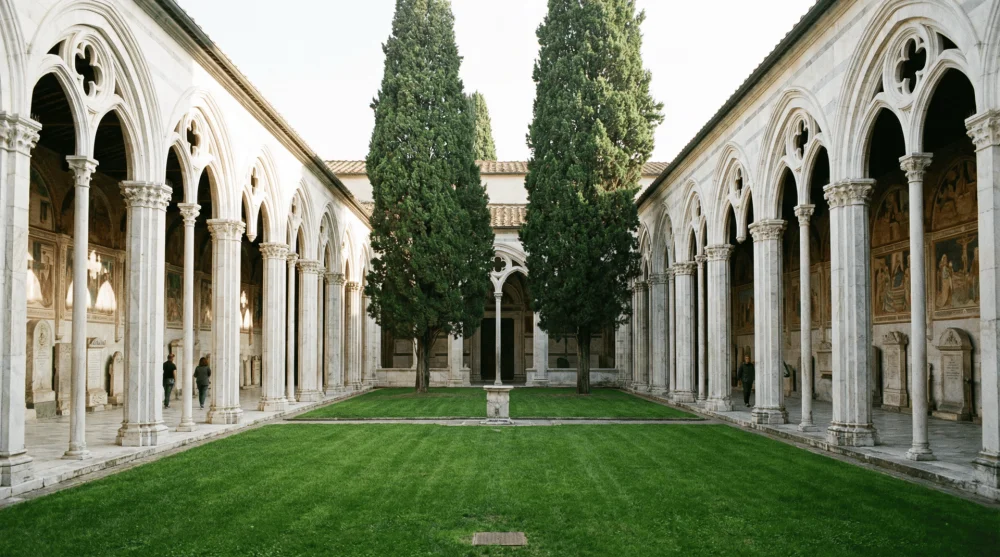
You are standing in the Square of Miracles, surrounded by thousands of tourists trying to hold up the Leaning Tower. The noise is overwhelming. But just a few steps away, behind a long white marble wall, lies a completely different world. Silence, art, and a strange sense of peace await you here. Welcome to the Camposanto Monumentale, the most underrated part of the Pisa complex.
Most visitors skip this place because they don't know what lies inside. We are not just talking about a cemetery; this is an open-air museum where history whispers from the walls. Legends say the soil here is sacred, and the frescoes you will see are as impressive as the tower itself. Let's step inside together and discover why this Holy Field is the soul of Pisa.
Practical Information for Visitors
Before we get into the legends and art, let's sort out the logistics. You don't want to waste time in line when you could be admiring medieval masterpieces.
Entrance Fee & Combined Tickets
If you only want to visit the Camposanto, the single ticket costs 7 EUR. However, we strongly recommend the Complete Visit option. For just 10 EUR, you get access to the Camposanto, the Baptistery, the Sinopie Museum, and the Opera del Duomo Museum. Considering the wealth of art inside, this is a steal in 2026.
Important: The entrance to the Cathedral is free, but you still need a ticket. If you buy a ticket for the Camposanto, you automatically get a free pass for the Cathedral at any time.
Opening Hours & Best Time to Visit
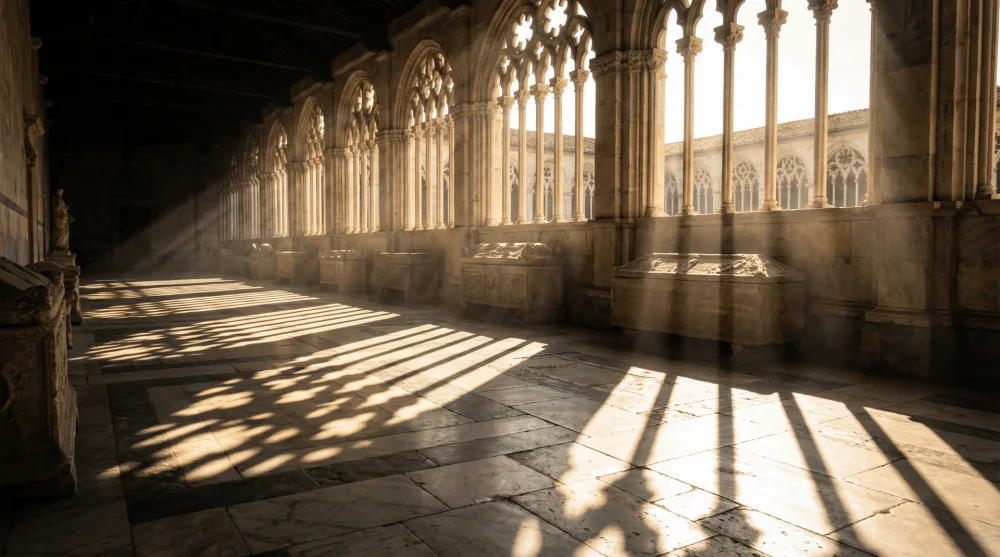
The gates usually open at 09:00 and close between 17:00 and 20:00, depending on the season. The best time to visit is right at the opening or late in the afternoon. While the crowds rush to the tower in the middle of the day, you can enjoy the Gothic cloisters in solitude during these off-peak hours.
How to Get There
From Pisa Centrale station, you have two good options. You can take the LAM Rossa bus and get off at the Torre stop, or you can enjoy a 20-minute walk through the city center, crossing the Arno River. We prefer walking; it gives you a chance to see the real Pisa beyond the tourist traps.
Why is it Called Holy Field? (The Legend)
This is not your ordinary burial ground. The name Campo Santo literally means Holy Field, and there is a fascinating reason for it. Legend has it that in the 12th century, during the Fourth Crusade, the Archbishop of Pisa, Ubaldo Lanfranchi, returned from the Holy Land with a very special cargo.
He brought back shiploads of sacred soil from Golgotha, the hill where Jesus was crucified. They spread this earth over the burial ground where the Camposanto now stands. The local belief was quite intense: they said that bodies buried in this holy soil would decompose in just 24 hours. While we can't test that theory today, walking on this ground definitely feels different knowing its history.
Masterpieces You Must See: The Frescoes
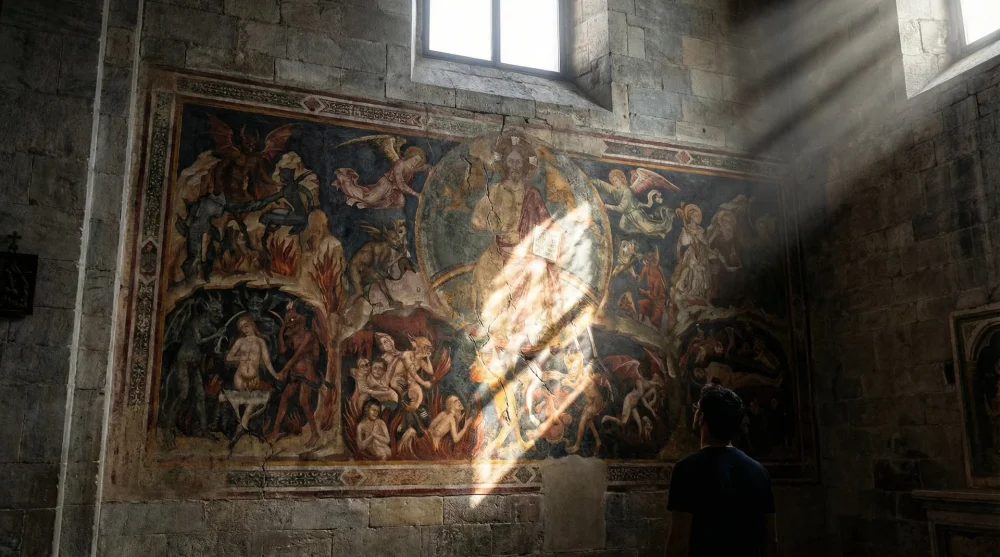
The walls of Camposanto were once covered in more than 2,000 square meters of frescoes, earning it the nickname The Sistine Chapel of Pisa. Sadly, a bomb fragment during World War II caused a fire that melted the lead roof and severely damaged these artworks. But thanks to a massive restoration project finished recently, you can now see them in their original glory.
The Triumph of Death
This is the star of the show. Painted by Buffalmacco in the 14th century, The Triumph of Death is terrifying and captivating at the same time. You see young nobles enjoying a hunting trip, only to be stopped by three open coffins containing rotting corpses. It is a brutal reminder of Memento Mori - remember that you will die.
Look closely at the details: angels and demons are fighting for the souls of the dead. The demons are dragging souls to hell, while angels try to save them. It is storytelling at its finest.
The Last Judgement and Hell
Right next to the Triumph of Death, you face the Last Judgement. The depiction of Hell here is chaotic and gruesome. If you are a fan of literature, you will immediately notice the connection to Dante Alighieri's works. The way sinners are punished mirrors the descriptions in the Divine Comedy. Speaking of which, if you are planning to explore more about the poet's life, you might want to check on the Dante House Museum in Florence after your Pisa trip.
The Pantheon of Pisa: Sarcophagi & Tombs
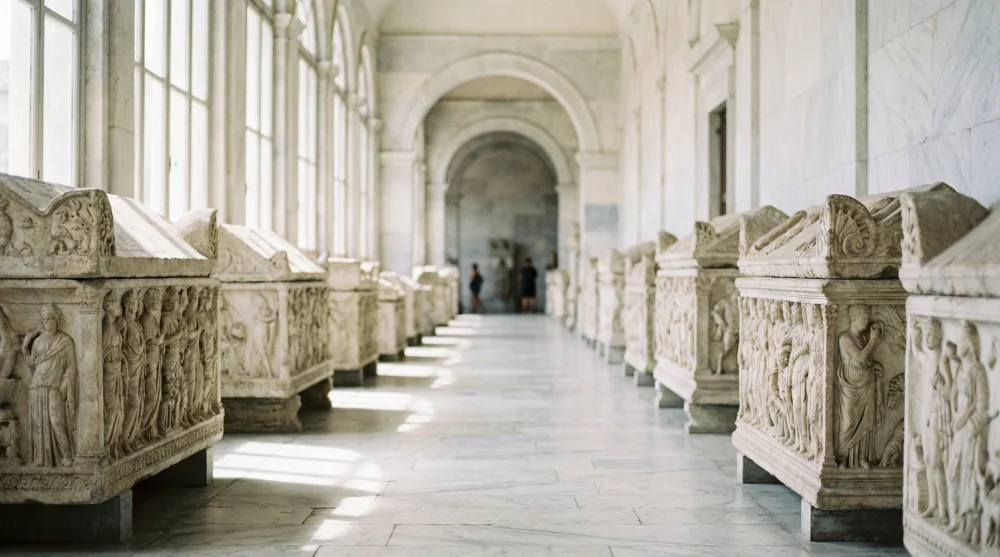
As you walk through the corridors, you are literally walking over history. The floor is paved with the tombstones of nobles, and the hallways are lined with ancient Roman sarcophagi. There are currently 84 Roman sarcophagi here, a collection that was reused by prominent Pisan families in the Middle Ages.
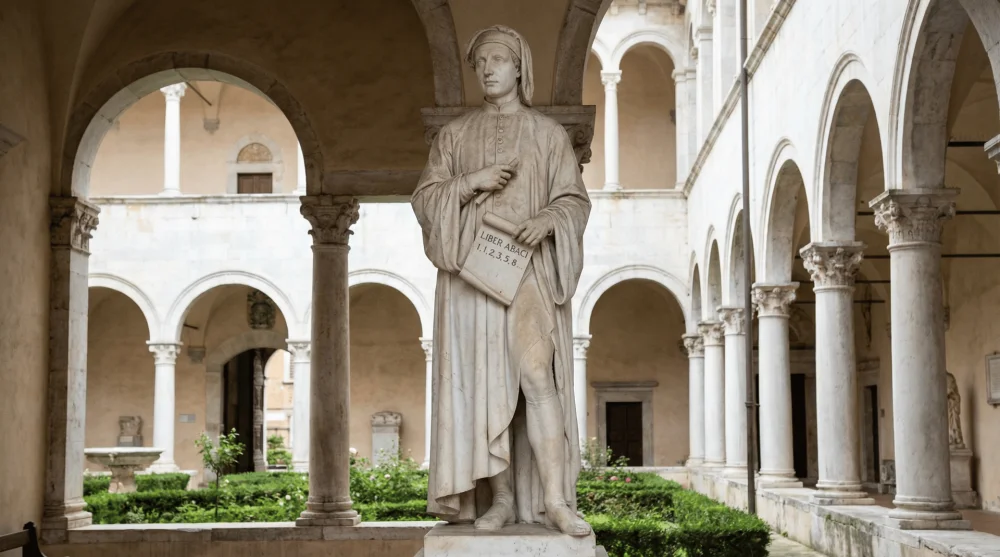
Leonardo Fibonacci’s Statue
Yes, that Fibonacci. The mathematical genius who introduced the sequence that bears his name (0, 1, 1, 2, 3, 5...) was born in Pisa. For a long time, his statue was moved around the city, but it has finally found its home here in the Camposanto. You can find him in the western corridor. It is a quiet spot to pay respects to the man who changed the way we count.
Hidden Gems Inside the Cloister
Don't just look at the walls; there are other treasures hiding in plain sight.
The Chains of Porto Pisano
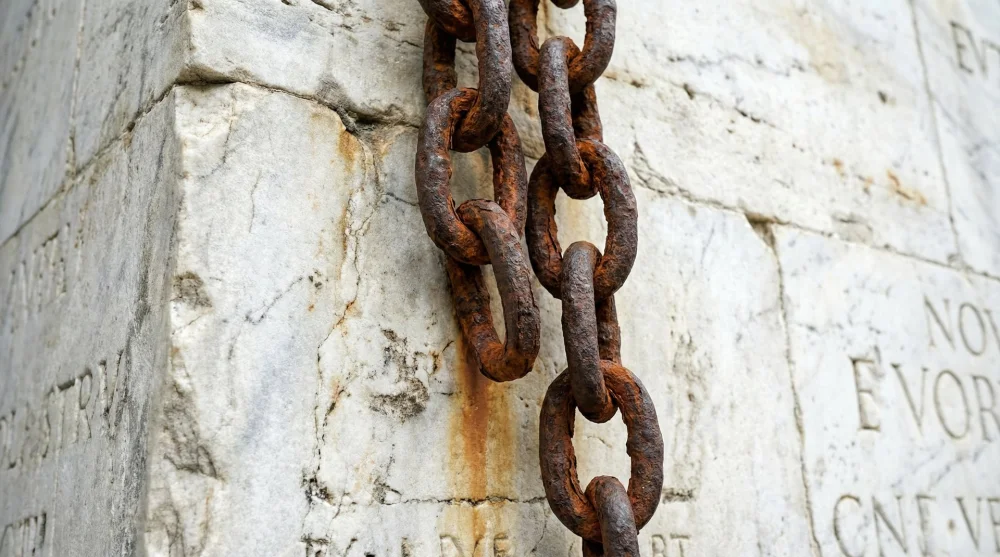
Hanging heavily on the wall, you will see massive iron chains. These are not just decoration. They are the broken chains of the ancient Port of Pisa. In 1284, after the crushing defeat at the Battle of Meloria, the rival city of Genoa took these chains as a trophy to humiliate Pisa. They were only returned after the unification of Italy hundreds of years later. Seeing them here is a powerful symbol of the city's rise and fall as a maritime republic.
Galileo Galilei’s Lamp
Inside the Aulla Chapel, you see a votive lamp. Legend says this is the lamp that a young Galileo watched swinging in the Cathedral, which inspired his theory of the pendulum. However, we have to be the ones to break the myth: the actual lamp Galileo saw is smaller and still in the Cathedral. The one here is beautiful, but it was cast a few years after his discovery. Still, it makes for a great story!
Is Camposanto Monumentale Worth Visiting?
If you appreciate silence, history, and art, the answer is a resounding yes. While the Leaning Tower is a fun photo op, the Camposanto is where you connect with the city's past. It offers a cool retreat from the summer heat and a break from the noise. In our opinion, leaving Pisa without seeing the Triumph of Death is like going to Paris and skipping the Louvre.
So, grab that combined ticket, step into the shade of the cloister, and let the history of Pisa surround you.

![Seychelles Trip Cost: Detailed Budget Breakdown [year]](https://www.rotasenin.com/uploads/2026/02/self-catering-guesthouse-tropical-garden-veranda.webp)
![Best Rides at Disney's Animal Kingdom: Ranked & Reviewed [year]](https://www.rotasenin.com/uploads/2026/02/avatar-flight-passage-banshee-ride.webp)
![Rome Pantheon Visiting Tips: Entry Fee, Hours & The Oculus [year]](https://www.rotasenin.com/uploads/2026/02/tourist-queue-ticket-line-piazza-della-rotonda.webp)
Comments (0)
Sign in to comment
Report